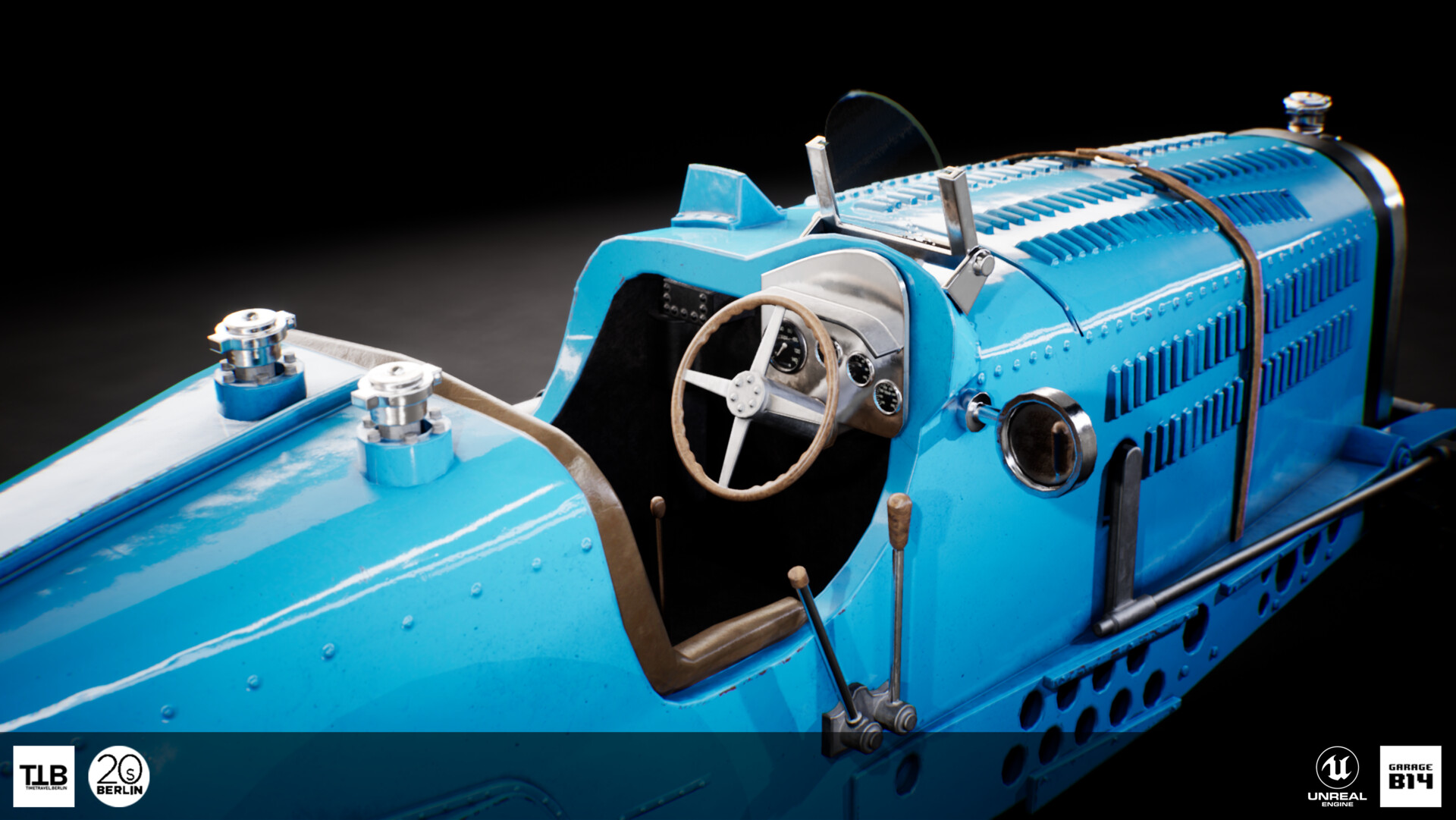
Bugatti Type 59 1934
The most beautiful Grand Prix car in history
Ettore Bugatti, born in a very artistic family, had a very artistic approach to building his race cars. Not only the overall design but every single detail of his creations were highly sculptural and beautiful. The Type 59 is regarded by many as the most beautiful Grand Prix car in history because of its outstanding lines but also by many details such as the drilled chassis, the perfectly shaped aluminum panel over the cockpit, and the design of the wheels (referred to as "piano wire wheels").
In the early thirties, Ettore Bugatti had lost interest in cars, leaving the responsibility of the Molsheim factory to his son Jean Bugatti. Caused by changed regulations to a new Formula Libre, Jean Bugatti developed the Type 59 Grand Prix based on Type 57 features a 3.3 litre eight-cylinder engine with Roots-type supercharger, dry sump, Scintilla Vertex magneto, and a much-refined suspension with De Ram shock absorbers.
Top drivers René Dreyfus, Robert Benoist, Jean-Pierre Wimille, Tazio Nuvolari and Count Brivio were engaged as works drivers on the Type 59. After promising results in 1933-1934 (Spanish GP 4th, Monaco 5th, French GP 4th, Belgian GP 1st, Swiss GP 3rd, Spanish GP 3rd), the Type 59 did not fulfill the great expectations: due to financial difficulties, the Type 59 came out much too late and proved to be unreliable; on the other hand the German government sponsored Mercedes-Benz and Auto-Union became all dominant by virtue of the unlimited funds available.
This particular car 59124 was raced almost exclusively by works driver René Dreyfus who was reasonably successful including an outright victory at the 1934 Belgian Grand Prix at Spa. After all four works cars had been sold to English privateers at the end of the 1934 racing season, the Hon Brian "Bug" Lewis (a wealthy amateur) raced the car 1935-1936 in England. Subsequent owners were Freddie Dixon, Jack Lemon-Burton, C.I. Craig, Reg Parnell, John Gaul, and Rodney E. Clarke, in whose hands the car was kept in good condition in spite of being raced extensively.
This is one of the models that was made for the "Time Travel Berlin" VR game where you can travel to 20's Berlin streets.
With this travel machine, you can move to the 20th century.